

As NASA astronauts are heading back to the moon for the first time in more than 50 years, a group of engineering students in Berrien Springs is doing its part to help make future missions to the lunar surface possible.
At Andrews University, three senior engineering students are working on a project tied directly to the growing push to build a sustained human presence on the lunar surface. It’s not science fiction—it’s the kind of behind-the-scenes work that could help future astronauts land, move around, and eventually live on the moon.
The students are partnering with Astroport Space Technologies, a company focused on building the infrastructure needed for long-term lunar operations. Their work connects to development of the FLEX lunar rover, a vehicle designed to transport materials and support exploration once crews arrive.
So what exactly are they doing?
In simple terms, they’re tackling a very down-to-earth problem—rocks and dirt.
Before any kind of lunar base can be built, the surface has to be prepared. That means dealing with the moon’s rugged terrain, including large rocks buried in the dusty soil known as regolith. The Andrews team is designing a tool that could attach to a lunar rover and help separate larger rocks from finer material, making it easier to move and use that soil for construction.
It’s the kind of practical engineering challenge that doesn’t make headlines—but without it, bigger plans don’t happen.
The project came together through the university’s Center for Innovation & Entrepreneurship, which connects students with real-world industry work. In this case, that connection stretches all the way to the space sector, where both government agencies and private companies are racing to establish a foothold on the moon.
Students involved say they’re not just working on a class assignment—they’re collaborating with engineers, meeting regularly with industry professionals, and designing something that could eventually be used beyond Earth.
Faculty say that’s what makes the experience stand out. Instead of theoretical exercises, students are working within real constraints, deadlines, and expectations—much like they would in a professional engineering setting.
For a small university in Southwest Michigan, it’s also a notable step onto a much larger stage. Partnerships like this are helping position Andrews’ engineering program as a player in the rapidly evolving aerospace field.
And while the spotlight will be on astronauts when the next lunar landing missions launch, some of the groundwork—quite literally—may trace back to a student project in Berrien Springs.
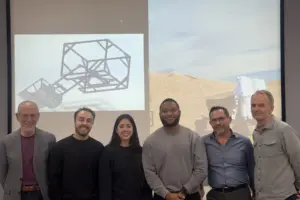
Andrews University students involved in Astroport research.