

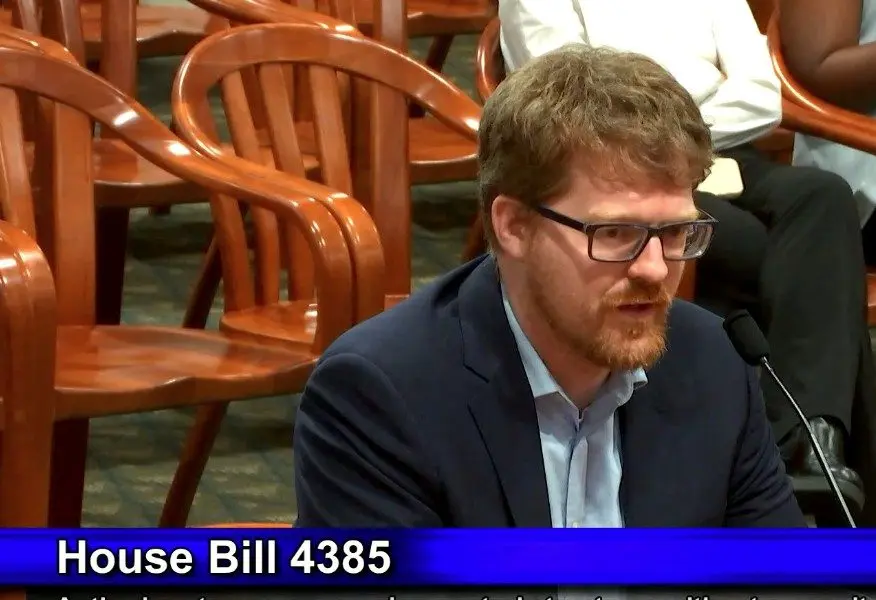
A decision this week by Michigan Attorney General Dana Nessel will likely lead to the restoration of nearly $650 million in funding for projects all over the state after a legislative move by House Republicans in the fall temporarily pulled that money back.
State Representative Joey Andrews tells us the Republican clawback of funding was possible thanks to an almost never-used procedure enabling an appropriations committee to reject project funding without legislative or the governor’s approval. He says when the Republicans made the recission, a member of the state Senate sought an opinion from the Attorney General. She’s now said the Republicans couldn’t do that.
“Dana’s decision not only invalidated the action, but also invalidated the clause in the law that allows one appropriations committee to do a rescission to basically determine that it violates the separation of powers and the principle of bicameralism by letting one chamber and one committee within a chamber unilaterally make a decision on money that’s already been appropriated,” Andrews said.
Andrews says the decision from Nessel is legally binding. He welcomes it.
“I was surprised that she found the whole mechanism unconstitutional. I thought she might just find the way that they voted on it to be a violation. But I think the outcome is good. And the nice thing is that as long as her decision is upheld, this won’t ever be able to happen again.”
Andrews says House Democrats have received guidance advising them to tell affected entities in their districts to be ready to receive the funding that was pulled back.
“We’re expecting all of the grants that were in that rescission process to begin being funded again. So we’ve told all of our local grantees who were affected by this that they should expect to hear from whichever agency was administering their grant and that their funding should be restored.”
This affects several projects in 38th Michigan House District, served by Andrews.
“The city of Bridgman for their city hall project, the Berrien Talent Collaborative, the $500,000 that was funding part of that project, and then the business incubator up in South Haven, as well as a senior center that we funded up in Casco [Township].”
Andrews says House Republicans have pledged to sue to overturn the AG’s decision, but barring the issuance of an injunction, the money already approved as part of the budget by the Legislature should start to flow. He calls the whole incident strange.
“The Republicans could sue to try to overturn the Attorney General’s opinion, but I was like, you know, in these grants, there’s money for wigs for kids with cancer. There’s the RxKids money that funds young mothers and provides medical care for newborns. Do you really want to be seen suing to suspend money for young mothers and kids with cancer? The optics of it are just pretty baffling to me.”
House Republican leaders say when approved funds are not spent, they can, in fact, be clawed back.
Nessel’s opinion finds the Separation of Powers requirement in the Michigan Constitution limits the ability of one branch of government to exercise the functions of another. She adds the presentment and bicameralism requirements reflect the constitutional mandate that laws must be debated and passed by both houses of the Legislature and presented to and signed by the governor.
“By empowering a single legislative committee to negate the State Budget Director’s work-project designations, the statute reserves the very administrative control that the separation of powers forbids,” wrote Nessel in her opinion. “This disapproval mechanism effectively creates a ‘legislative veto’—or, more accurately, a ‘legislative committee veto.’ This comprises an unconstitutional reservation of administrative control that interferes with the executive branch’s core function of executing the laws. Under Article 3, § 2, when an appropriation is enacted, the Legislature’s role ends, and the executive branch’s duty to faithfully execute the law begins.”