
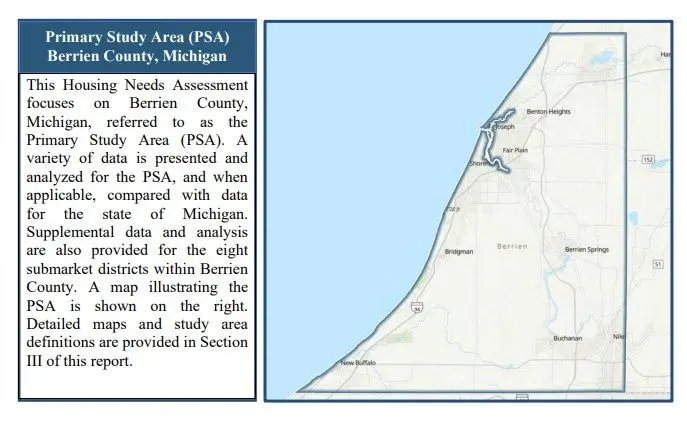
Cornerstone Alliance has released its long-awaited Berrien County housing study, putting the area’s housing shortage into focus with concrete data.
Cornerstone hosted an event this week in Three Oaks with municipal leaders, developers, and community stakeholders all on hand to learn what the Berrien County Housing Needs Assessment has found. Cornerstone Alliance Senior Vice President Andrew Haan tells us the assessment points to a shortage of attainable housing, particularly for working households.
“Over the next five years, there’s a gap between demand and supply for an additional 4,000 rental units and 2,200 for-sale units,” Haan said.
The analysis identified a significant gap in homes priced under $300,000, limiting options for young professionals, families, seniors, and the local workforce. It finds a shortage of both affordable homes for purchase and affordable homes for rent, whether they’re houses or apartments. Haan says there are multiple reasons.
“The cost of construction has been very high. We have more households in the community than we did previously, despite the shrinking population. Those households are smaller, and they’re taking up more housing. We also have a lot of commuters, about 17,000 people commuting into the community daily.”
And Haan says many of those commuters would live here if they could find a place.
In the rental market, the vacancy rate is just 0.6%, when 4% to 6% is considered healthy. Among homes for sale, the county’s median home price increased from $239,000 in 2021 to approximately $300,000 in 2025, with current listings averaging closer to $439,900.
“There are huge issues. The average price has gone up by tens of thousands of dollars just in the last five years,” Haan said. “So making sure that as new housing comes online, it’s not just at the top end of the market is still important. We still need that type of product, both for sale and for rent, but we also need to ensure we’re building units that work for the workforce we need. That’s one of the key reasons Cornerstone is involved in this work, because this is an economic development issue.”
As costs rise, more households are experiencing financial strain, with more than 17,000 spending more than 30% of their income on housing. The report also highlights a growing senior population, which is expected to increase demand for smaller, accessible housing and senior care facilities in the coming years.
Haan says there are currently hundreds of units under construction around the county, suggesting that closing the gap is possible with the right policies.
“We have to at least start with an understanding of what the demand is to set some reasonable goals. There are already at least 500 units, if not more, under construction or in the pipeline right now in just a couple of communities in the county. So it’s viable to consider 2,000 or 3,000 new units coming in the next five years if communities make it a priority, taking concrete steps to identify sites for housing, ensuring zoning and permitting are ready, and leveraging available tools. It is tough to make the numbers work on housing investment, so we’ve got to make sure we’re doing everything we can as a county and within individual communities to foster an environment where it makes sense to invest.”
Cornerstone will use the results of the study to court developers and help municipalities follow policies that could make home construction feasible for them. In fact, Haan says while the organization was presenting the study this week, he met a developer interested in learning more about opportunities in the area.
“That led to someone asking me, ‘Hey, I’ve never been to Berrien County before. We’re Grand Rapids-based. Can you show me around?’ I ended up spending the rest of my afternoon with them, showing opportunities in Benton Harbor, St. Joe, and beyond. So we’re working every day to spread the word, communicate these opportunities, and make sure communities are ready when developers come knocking.”
And Haan says he believes more developers will come knocking. It’s part of Cornerstone’s job to help make projects easier for them and court more investment. He says he has been encouraged by some of the developments he’s been seeing.
“The market is responding, just not fast enough. Each community has its own unique characteristics and needs, and now they’re armed with data to understand what can be supported. What comes next is really digging in and understanding what can be supported and seeing where that lines up with the community’s vision for what they want to be. Where there is alignment, they should be intentionally working to foster those projects.”
Cornerstone Alliance worked with Patrick Bowen of Bowen National Research on the housing study. Haan says he’s a leading researcher in this area.
You can find the study right here.
More housing information from Cornerstone can he found here.