
Pull together two dozen manufacturers from almost any community in America and you would likely have witnessed the same over-arching consensus that the most critical challenge on the industrial front is talent. Pure and simple. There aren’t enough people to go around, and the issue isn’t going away anytime soon.
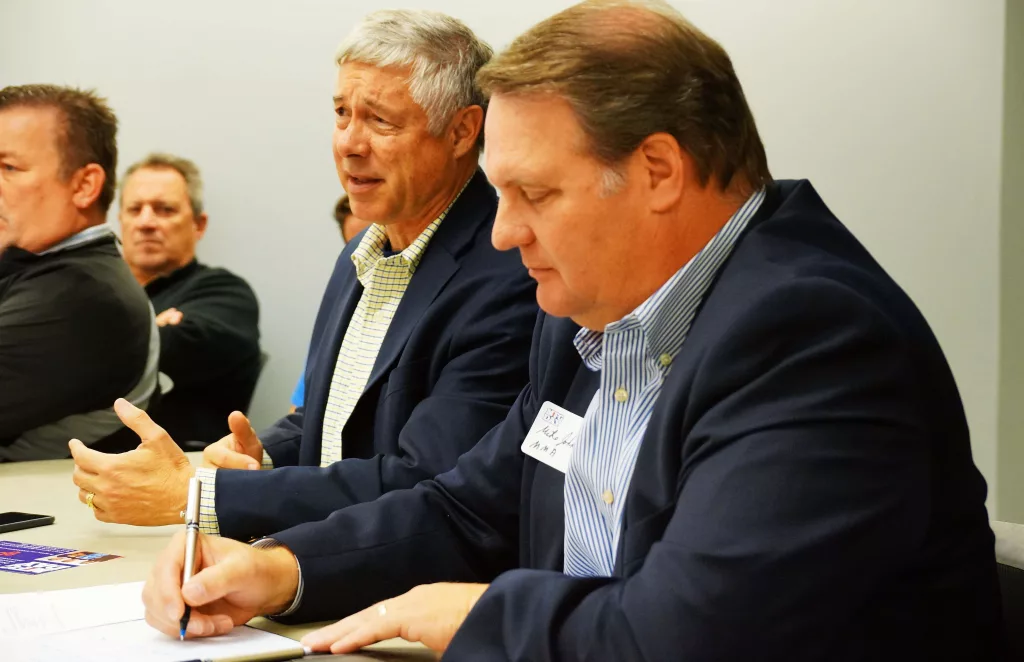
The two dozen manufacturers, legislators, educators and economic development professionals who attended the Manufacturing Day Legislative Roundtable discussion at Bosch in St. Joseph today shared the steady drumbeat of manufacturers everywhere: Find. The. Talent.
While Manufacturing Day is set aside annually every year in a bid to accomplish that task, the issue is never far afield as proven today when the Michigan Manufacturing Association’s Vice President of Government Affairs Mike Johnston asked the straight forward question: What keeps you up at night? What’s your greatest barrier to competitiveness?
Without hesitation came the responses one after another: “Labor! Talent! Finding Talent! Skilled Labor! Even Un-skilled Labor!”
Nobody in the room was surprised by the answer, least of all Johnston. Nevertheless, he opened his remarks by saying, “Man this is a great day, and this is what manufacturing should be about!” While Johnston noted that today’s Kinexus-sponsored event at Bosch was just one of 245 other Manufacturing Day events in the state of Michigan alone today, “This may be one of the biggest. I don’t know the numbers, but that’s really impressive.” He was talking about the more than 900 students at Bosch and another 500 to 600 at AACOA in Niles under the guidance of Kinexus.
Johnston, calling the manufacturers the “dignitaries” in the room, told them, “I want you all to know so you can share this at cocktail parties and the like, manufacturing is the largest sector of the Michigan economy, by far. It’s like twice as big as the next sector which is real estate, and manufacturing drives the value of real estate, too. So be very proud, because Michigan is also leading the nation in manufacturing job growth and has for several years.” He told the roundtable participants, “We created 171,000 new jobs in Michigan since June of 2009, so if anyone talks about the ‘Rust Belt,’ or the ‘Dying Midwest,’ tell them that Michigan is leading the nation, not some California or Texas or New York. It’s Michigan.”
There were many industrial reps on hand at the roundtable along with Congressman Fred Upton, State Representatives Kim LaSata, Beth Griffin, and Dave Pagel as well as Adam Mensinger representing State Senator John Proos. Johnston applauded the legislative contingent as “tremendous legislators who vote with us, and support the issues we work on, and we are truly blessed to have them.” He added, “They get it. They understand what drives the economy, and they vote with us, and they’re with us.”
Recognizing the skilled workforce issue, Johnston pointed to the low unemployment rate throughout West Michigan, which further exacerbates the talent problem, and the proliferation of baby boomers who are retiring and getting out of the workforce. Johnston also cited the manner in which, over the years, “Merit curriculum has over the years pinched out career tech programming, so we haven’t captured the aptitude for manufacturing in the high school system, and I think that’s a crime.”
Another widespread concern of the manufacturers is the throat punch of social issues keeping workers from getting ahead. Essentially, the kind of worker who develops car problems due to the inability to get ahead and stay ahead, or those who are confronted with escalating day care issues.
Transportation is another hot button, especially in poor urban areas and in the wide open reaches of rural areas. Congressman Upton asked how many employ a ride-share program, encouraging co-workers to car pool or ride share their way to work, but only two or three manufacturers use that methodology.
Pat Brandstatter of Kruger Tool in Bridgman is working with the Michigan’s Great Southwest Strategic Leadership Council on the difficult nature of public transportation in the area, and said it goes beyond simple transportation to outright mobility because so many are restricted. He cites the struggle to garner consolidation of the four public transit systems scattered across the county into a single entity to strengthen the effort. It has a direct impact on his own business, as well, since many Benton Harbor residents work at Kruger Tool in Bridgman.
There was a fair measure of debate over the nature of the work ethic in the region which is hampered by the mentality that some people actually make more money off of public assistance than if they were to get a job. The ongoing debate of how to structure welfare and other public assistance programs drew a multitude of comments from legislators and manufacturers alike.
Some manufacturers are utilizing an Employer Resource Network, sometimes called “The Link,” as a good model for helping people deal with some of the social issues like flat tires, broken furnaces, and so on.
Food insecurity which leads to hunger issues, transportation, mobility, work ethic, lack of skills and similar topics filled the better part of the hour long roundtable discussion, and Upton wondered if the timing of Manufacturing Day wouldn’t be better captured in the spring when folks could then leap into summer jobs to help fill the void.
One response was quite blunt. Many of these people who tumble in and out of the workforce are living literally day-to-day — in the moment — not next week, or next month, and they need to be catered to in the frame in which they live.
One participant argued that the social issues sometimes are exacerbated by the difficulty of “navigating the system,” of forms, red-tape, and other government hurdles, and the whole system is skewed “backwards,” inasmuch as we shouldn’t be paying people who don’t want to work, we should help those who do want to work, but “perhaps the safety net is too good.”
Immigration issues arose as well, citing migrant workers as some of the hardest working people around but increasingly unavailable due to rules and regulations.
Upton said there might be light at the end of the tunnel with the tax bill currently underway which would lower the corporate tax rate from 38-percent to 20-percent, and that could provide incentives for additional expansion, more jobs and help for those looking for work as America becomes more competitive in the global marketplace.
Johnston encouraged manufacturers to continue to talk to one another to help build the pipeline of talent needed now and in the future, and to continue to expose kids to the possibilities of a lifetime in the world of manufacturing. The drive to start the education process in the early grades can help turn the tide.