
Last Week, MoodyOnTheMarket.com reported on our conversation with Benton Township real estate developer Jim Paul focusing on the viability of the $7.5 Million Dollar asking price for the 63-acre mall site, recently announced by Durga Properties, the most recent mall owner. Today, we look beyond the price question to ‘what might be possible with the right players involved’?
In our conversation with developer Paul, we discussed what has worked in some other areas where 1980s shopping malls withered and died. What replaced them? In many cases, ‘nothing yet’. However, in some places the ‘Town Center’ concept has emerged as the next chapter for the communities left with huge expanses of asphalt and decaying structures.
What is a Town Center in this situation?
Essentially, it is a multi-use development—or several related ones—that would transform the former mall site into a mini-community, a village of sorts that takes shape over several years based on the needs of multiple entities who would be working together—not one gigantic player like Costco, Sam’s Club, Target or Menards.
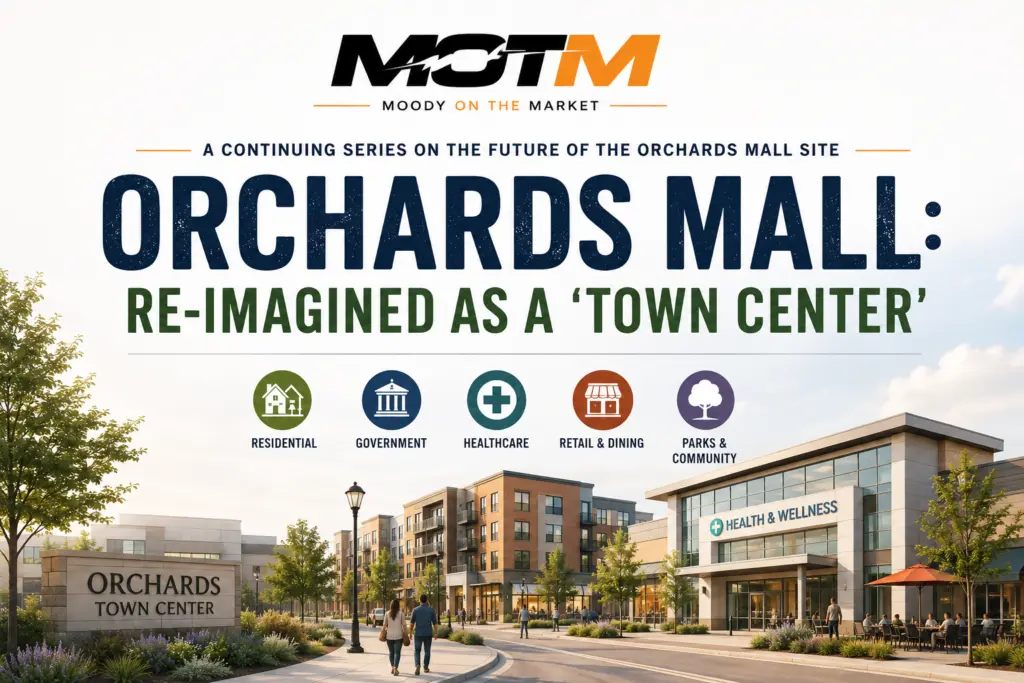
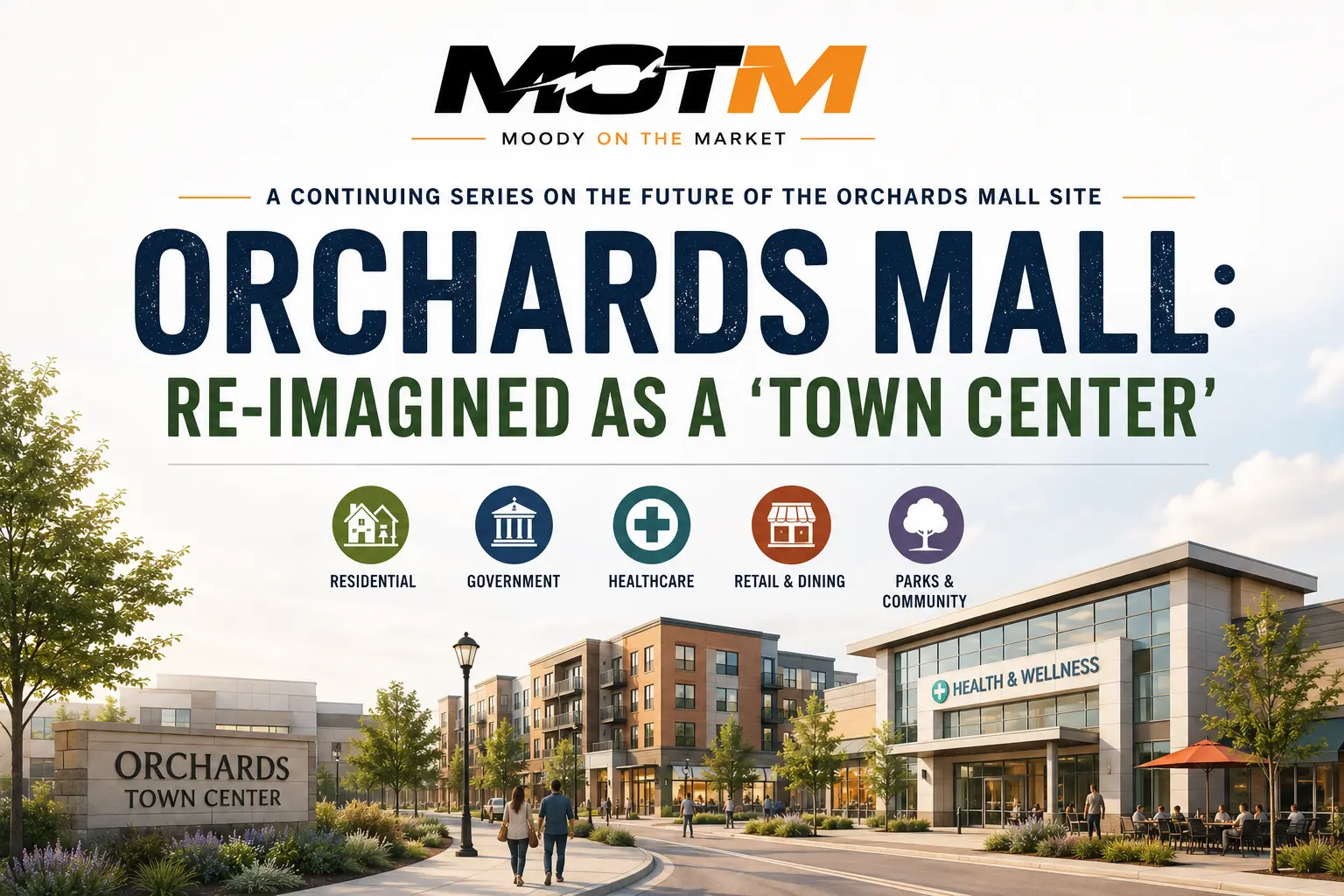
Likely, it includes significant residential development of apartments and townhouses, local government offices, non-profits and public services, medical facilities and offices and compatible retail and commercial businesses specifically designed to conveniently serve the neighborhood residents and surrounding area. In many ways it functions almost like a ‘small town within a larger one’.
Residential development would be primarily rental units, with perhaps some condominiums. It would be targeted at younger working people—singles and couples, and older residents—approaching or at retirement age. They would be attracted by the convenience of nearby existing shopping, restaurants and important services—within walkable distances in some cases. The existence of those people would attract additional small, service-oriented retail, just as it exists in other commercial zones—downtowns– in the region. Eventually the jobs generated in the developing neighborhood could drive a second wave of residential demand, helping the Town Center grow beyond its initial population.
In our discussion with developer Paul and subsequent research for this article, it became clear that if a Town Center concept is to be the future of the Orchards Mall, Berrien County government and Corewell Health would necessarily be two key players. Government services and convenient medical care would be a key element in a successful Town Center concept that would have a chance to grow and prosper. The support and involvement of Benton Charter Township would be important, but the scope of the project would require the resources, reach and vision of government at the Berrien County level.
Berrien County leaders have conceptually discussed the eventual relocation of additional County offices and services at Napier Avenue, Exit 30 near the current Berrien County Health Department. Over time, the Courthouse, County Law Enforcement Center and Administration Building in St. Joseph would likely migrate to Benton Township. This has been predicted to happen over the next couple of decades in various discussions of long range planning at both the County and City of St. Joseph levels.
The question may be asked—so we will ask it—wouldn’t more people, both county government customers and county employees, be even better served by new Berrien County offices and services in future locations at 1800 Pipestone Road—the Orchards Mall location? They would be surrounded by desirable and convenient services. And, if the Town Center developed as envisioned, there would be convenient residential space very close to their employment.
Following the same logic, Corewell Health is the largest employer in Berrien County and will only grow in the future as a division of Michigan’s largest health care entity. New, expanded facilities for medical specialties and replacements for scattered or outmoded offices will be located somewhere in the Twin Cities area. If not directly tied to the Lakeland/St. Joseph Hospital or Hollywood Road Outpatient Services Center, wouldn’t it make sense for Corewell to consider being a major player in a Town Center redevelopment at the Orchards Mall site? Accessibility for patients, new residential opportunities for employees and convenient nearby services for both would commend the site for consideration by Corewell planners and leadership.
An important factor unites both Berrien County and Corewell Health, and potentially makes them the most likely ‘lead’ developers for a Town Center project at the mall site: they are non-profit organizations. Their mission is to serve the public while still paying for the critical services they provide. Just as with the original Harbor Shores development 20 years ago, some projects move forward only as a non-profit entity. The capital required and the risk/reward equation drive private investors in another direction.
Visionary local leaders, however, can, if they choose, find ways through government action (often tax policy) and public-private partnerships to move projects forward that would otherwise not happen. Harbor Shores stands today as a symbol of that creative ‘imagineering’.
Our Conclusion…
A Town Center concept at the mall site, with a core of government and health facilities, residential for younger and older people, and compatible independent commercial, retail, restaurant and entertainment entities offers a genuine opportunity for a positive next chapter for the mall property.
Moving forward, MoodyOnTheMarket.com will seek comments and reactions to this development concept from leadership at Berrien County, Benton Charter Township, Corewell Health, Cornerstone Alliance, Southwest Michigan Regional Chamber and other potentially impactful groups and individuals. It should be emphasized that this concept is offered as an idea starter, certainly not a detailed plan. If meaningful discussion is generated that will itself be a positive result.
By Gayle Olson, MOTM Contributor
Background Summary: Town Center Concept
For those interested in more background on the concept of a Town Center as the future of the Orchards Mall site, here is a deeper dive into our notes on what has been accomplished in a few former mall sites:
Former mall properties are often best redeveloped as mixed-use community hubs rather than replaced with another traditional retail center. The most successful projects usually combine several uses, so the property stays active throughout the day and evening.
Common redevelopment options include:
- Housing, including apartments, senior living, or townhomes
- Medical offices and healthcare campuses
- Community colleges, training centers, or satellite university facilities
- Entertainment venues like theaters, sports complexes, or family activity centers
- Restaurants and smaller retail spaces designed around walkability
- Office or coworking space
- Public services such as libraries, city offices, or community centers
- Indoor recreation facilities
- Logistics or light industrial uses in some cases
Across the U.S., some former malls have become “live-work-play” developments with streets, green space, housing, and public gathering areas replacing large empty parking lots and enclosed corridors.
In similar mid-sized markets, the strongest opportunities often involve:
- workforce housing,
- healthcare expansion,
- recreation and tourism
- flexible commercial space for small businesses
The biggest challenge is usually financial. Older malls often require expensive demolition, infrastructure upgrades, environmental cleanup, or road improvements before redevelopment can happen.
Public-private partnerships, tax incentives, and phased construction are common ways communities make projects viable.
Many planners also emphasize avoiding large vacant asphalt areas by adding:
- parks,
- trails,
- stormwater features,
- and pedestrian-friendly design.
The most effective redevelopments usually reflect what a community lacks instead of trying to recreate the traditional mall model that declined in the first place.